
Web Design 09 Feb 2026
The Real Website Design Cost in Vancouver [2026 Price Breakdown]

Writen by Saeideh Rajabi
![The Real Website Design Cost in Vancouver [2026 Price Breakdown]](/uploads/blogs/1770623753.jpg)
Website Design Cost in Vancouver: What to Expect in 2026
Your website is one of the most critical tools for communication and business growth. However, a major challenge companies face is gaining a proper understanding of web design costs in Canada, and specifically, average prices in Vancouver.
When planning your website, you naturally consider your goals, target audience, and functionality—but your budget plays an equally crucial role. In fact, the most frequent question we hear from clients at LocalHost Digital Canada is: “How much does a website cost in Vancouver?”
The truth is, there’s no one-size-fits-all answer. Web design prices in Vancouver vary widely depending on the agency and the type of project.
In Vancouver, website design expenses vary significantly based on project complexity. While basic, budget-friendly sites can start as low as $500, sophisticated custom, corporate, or e-commerce platforms often exceed $10,000 to $50,000. For most small businesses, a standard 5-
to-7-page website typically costs between $5,000 and $15,000.
Click to view a sample website design
This wide pricing spectrum can feel overwhelming. However, the key to getting the best value for your investment is ensuring that your website goals, required features, and budget are perfectly aligned. Ultimately, it is a clear strategy, not just the price tag, that determines the long-term success of your website.
How Are Website Design Prices Calculated in Vancouver?
Aligning Your Budget with Your Business Goals
The reality is that a modern website is complex; it is no longer a simple digital product with a standardized, "one-size-fits-all" price tag. Because every business has unique needs and distinct goals for their online presence, the cost is determined by the specific strategy required to meet those demands. You must decide on the best approach to ensure your website fulfills your specific objectives.

The 05 Primary Website Design Cost Factors in Vancouver
1. Number of Pages
Direct and Concise Pages are the vital building blocks of your website’s navigation; the more you have, the more exponentially complex the project becomes. Simple sites usually need around 15 pages, whereas large businesses and e-commerce stores require far higher counts.
2. Unique Page Designs
In custom web design, every individual page relies on a specific template to organize its content. To optimize efficiency, similar pages often share structures, whereas high-impact pages like the home page demand unique templates. Therefore, the final cost depends not only on the quantity of templates required but also on the extent of bespoke, from-scratch design work involved.
3. Functionality
One of the most significant factors influencing price is the set of unique functions your website demands. You might run a clinic that necessitates an appointment booking engine, or a renovation business that needs a gallery to display past work. A successful website will always integrate the specific features required to serve your company effectively, but keep in mind that as the complexity of these functions increases, the cost will follow suit.
4. Degree of Involvement
our level of involvement directly impacts the final price: the more work you do yourself, the cheaper the project becomes. You might opt to handle the design, development, or content creation to avoid paying for those roles, but remember that you are sacrificing time and often the benefit of professional experience. With a sufficient budget, however, you can minimize your involvement and trust experts to deliver the results.
5. Ongoing Fees
Smooth & Natural Flow While the initial costs of design and development are significant, they represent only half of the investment. The other half involves the long-term costs of keeping the site running. Therefore, your budget must include provisions for recurring expenses such as web hosting and maintenance.
7 Primary E-commerce Web Design Cost Factors in Vancouver
E-commerce platforms are far more intricate than typical websites, and their pricing reflects this added complexity. Constructing an online store requires navigating several key variables that drive up costs. Grasping these factors will help you budget wisely and guarantee that the site aligns with your commercial objectives.
1. Product Pages Think of product pages as the shelves of your digital store. Each item requires its own page with specific buying tools. Consequently, the more products you sell, the more pages we build, and the higher the project cost becomes.
2. Handling Variations Products rarely come in just one format. Whether it’s size or color, handling these variations requires intricate setup, which is a key consideration in pricing.
3. Payment Gateways The ability to accept money securely is the engine of your store. This requires complex integration with payment processors, making it a more significant investment than a simple brochure website.
4. Inventory Tracking You need to know what’s in stock. Implementing a system that updates availability in real-time is crucial, but it adds to the development costs.
5. Smart Calculations To ensure a smooth checkout, your site needs to automatically calculate shipping and taxes based on location. This requires sophisticated backend logic, which contributes to the overall price.
6. User Profiles Personalized accounts allow customers to track orders and save preferences. While great for retention, building the database infrastructure for this feature increases the workload.
7. Long-Term Care A store never really closes. Ongoing costs for security patches, updates, and support are necessary to keep your business running smoothly after launch.
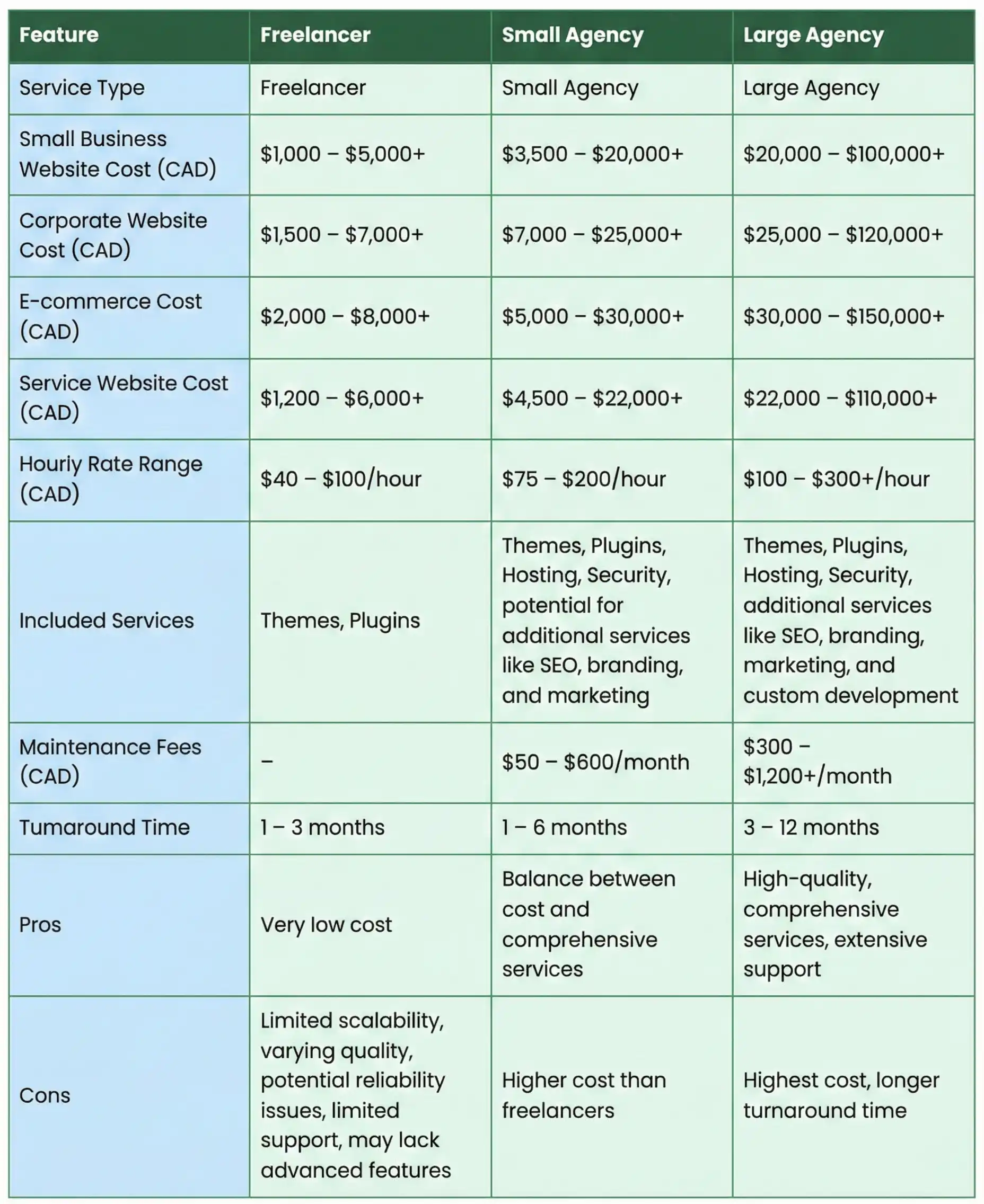
Website design prices for web designers/ web design agencies in Vancouver
Other Costs to Consider in Web Design Cost in Vancouver
The True Cost of a affrodable web design vancouver: Factoring in Growth Tools Building the website is just the first step. To make it a powerful business tool, you need to budget for the engines that drive traffic and conversion.
First, consider SEO. You can handle this yourself using tools like SEMrush ($100–$300/mo), hire a freelancer ($500–$1,500/mo), or engage a full-service agency ($1,500–$5,000+/mo) to guarantee visibility on Google.
Next is Content Creation. Your site needs a voice. Professional blog posts generally cost between $50 and $500, while high-converting landing pages can run up to $1,000 each. For online stores, expect to pay around $20–$50 for every unique product description.
Finally, account for the Technical & Visual Extras. Email marketing integrations (up to $300/mo), premium plugins for bookings or payments ($100–$1,000/yr), and professional stock imagery ($20–$200/item) are all standard expenses required to polish your digital presence.


